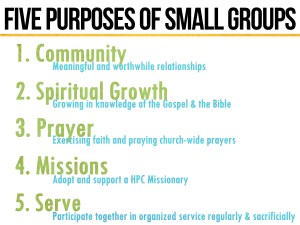
The next five posts will be about the five purposes and tasks in small groups. There are many things that cannot be done on Sunday morning. Some cannot be done because of time constraints. Some cannot be done because of the large group context. But when large group and small group gatherings work in concert with one another, great things can happen to the local church. It’s amazing what can happen to the local church when the local church is working right.
So to give you a summary, the five purposes are as follows:
One of the objections people have against small groups is that we don’t get to pick the people. Small group seemed like an artificially assembled group of people that don’t naturally get along or necessarily click with each other. Some groups are together for months and still don’t feel like they’re all that much closer. Some people openly long to not have to be part of a small group so that they can be more focused on spending time with people they know they can have meaningful friendships with. And many pastors realize that fighting this is a losing battle.
Over the next couple of weeks I want to publish a series of entries outlining the overall vision for small groups High Point. Generally speaking though vision is supposed to answer three questions: What’s the problem? What’s the solution? Why us why now?
1The LORD had said to Abram, “Leave your country, your people and your father’s household and go to the land I will show you. 2 “I will make you into a great nation and I will bless you; I will make your name great, and you will be a blessing. 3 I will bless those who bless you, and whoever curses you I will curse; and all peoples on earth will be blessed through you.”
Some people find the idea that we are counted righteous by God through believing his promise (Genesis 15:6) difficult to accept. Why should we be thought righteous for believing?
We don’t have to prove how it works. Christianity is a revealed religion, not a derived religion. That means we think we know this because it has been revealed, not because we figured it out. In that case, so long as the view isn’t incoherent, and the revelation source is trustworthy, then you are warranted to believe something even if you can’t prove, or even explain it.
Faith is the right ground to credit righteousness because it is the first step in being reoriented toward reality and what is good and just, which is embodies in God. Without faith in the true God, then no set of works can rightly orient a person towards reality- moral or otherwise. Without that reality reorienting faith, righteousness is implicitly refused. With faith, by accepting God’s righteousness, God opens us to be credited righteousness and as a vessel in which to develop that righteousness through faith.
That’s not the point of this doctrine. The dynamic of promise-faith as the dynamic through which we are made right with God is not what MAKES it work. It works because of other supporting and related truths- imputation, union with Christ and others.
How does it work? 2 options:
Use of debt metaphor. When people think of having righteousness credited to a criminal, they often struggle with the idea of a substitute sacrifice. Why is a criminal righteous because an innocent person took their punishment? But it depends on what metaphor of justice you use- criminal or civil. In civil cases, all crimes can be reduced to property and debt since all crime takes something from the person and the community. Justice requires the restoration of what was damaged or destroyed. That debt has to be paid by some kind of restitution. Sin is commonly treated as a kind of moral debt which is paid by Christ’s sacrifice.
Union with Christ. Another way to think about it is that through faith God offers union with himself, namely in the person of Christ. The union of Christ with a believer goes all the way down to being and identity, and the one becomes part with the other- though the metaphysics of that is never explained in detail. This means that the moral status of both are shared. This means that the believing human truly shares in the righteousness of Christ, and is counted righteous “in Him”.
It’s important not to pretend we know more than we do. And it is also important to make clear when we are speculating and when we are explaining something scripture clearly tells us.
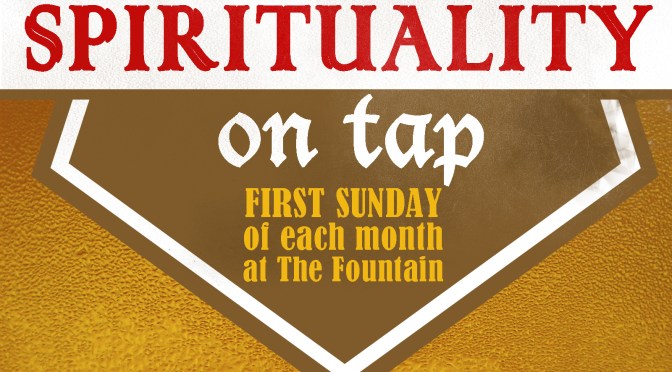
Everyone laments that we don’t talk to people different than ourselves and that it’s killing our culture, and then almost nobody does it. This annoys me – not just that people are hypocritical about this, but because I am too. Recently I’ve gotten together with three “progressive” Christian clergy to do something called theology pub or spirituality on tap. Essentially the concept is from the emergent movement, but is simple enough. Some people don’t like coming to churches or being on religious people’s home turf. However, this doesn’t mean they are shallow and don’t like talking about spirituality, God, morality, meaning and so on. So, you take the conversations about those things to their turf and of course that means going to a pub/bar.


 Continue reading Five Purposes & Practices of Small Groups: 1. COMMUNITY
 Engage & Equip